
Communicable Disease Prevention
A Study Assessing the Effectiveness of Deworming Combined with Hygiene Education
A baseline intestinal parasite survey supporting a randomized controlled trial on deworming combined with hygiene education across 100 primary schools in Phú Thọ, funded by EMW/Evidence Action.
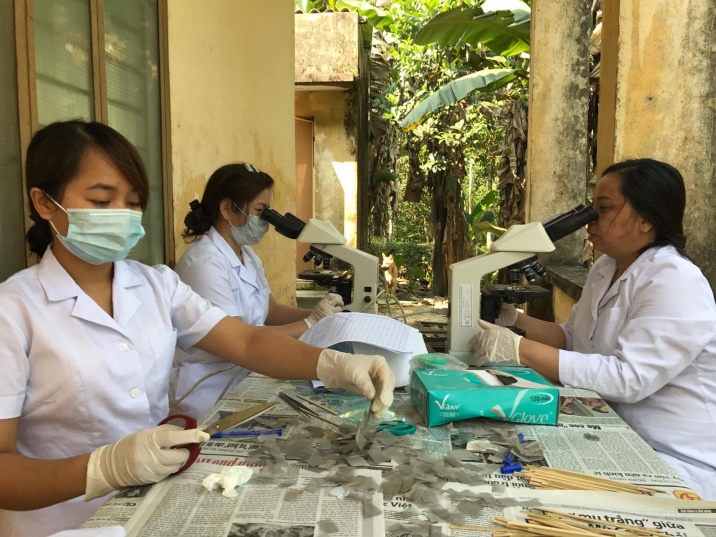
Project Overview
- Field: Research assessing the effectiveness of deworming combined with hygiene education
- Duration: 10/2017
- Funder: East Meets West Foundation (EMW) and Evidence Action
- Implementing agency: Center for Environmental and Health Studies (CEHS), in partnership with the National Institute of Malariology, Parasitology and Entomology (NIMPE) and international research partners
- Location: 100 primary schools across 12 districts/city of Phú Thọ province
Introduction
Soil-transmitted helminth (STH) infection remains a common public health issue in Vietnam, particularly in mountainous areas, with primary-school-age children at high risk. Under the school-based deworming program run by East Meets West Foundation and Evidence Action, a cluster randomized controlled trial was conducted to assess the effectiveness of combining hygiene education with school-based deworming in reducing reinfection among students. An intestinal parasite survey (STH Survey) served as the baseline, providing initial data on the prevalence and intensity of worm infection among grade 3 and 4 students before the intervention.
CEHS's Role
CEHS worked with NIMPE, East Meets West Foundation, Evidence Action and international research partners to conduct the baseline survey at 100 primary schools in Phú Thọ. CEHS helped develop the survey plan, coordinate fieldwork, train staff, organize stool sample collection, manage data, and support analysis to ensure data quality for the randomized controlled trial.
Key Activities
- Conducting an intestinal parasite survey of grade 3 and 4 students at 100 randomly selected primary schools.
- Training health workers, teachers and staff involved in sample collection, storage and testing.
- Enrolling over 15,800 study subjects across 12 districts/the city of Phú Thọ province.
- Conducting stool sample testing using the Kato-Katz technique per World Health Organization (WHO) guidance to determine STH prevalence and intensity.
- Managing, processing and consolidating survey data for the randomized controlled trial assessing the combined deworming and hygiene education model.
Key Results
- Conducted an intestinal parasite survey of 15,833 grade 3 and 4 students at 100 primary schools across 12 districts/the city of Phú Thọ, using the WHO-standard Kato-Katz technique.
- Overall STH prevalence was 10.24%, significantly lower than the 2016 Phú Thọ survey result (23.8%), reflecting the effectiveness of the school deworming program, which achieved about 98.2% coverage.
- Species-specific prevalence: whipworm (Trichuris trichiura) 8.33%, roundworm (Ascaris lumbricoides) 3.24%, and hookworm 0.58%. Cẩm Khê and Tam Nông districts had the highest prevalence (over 20%), while Đoan Hùng had the lowest (2.5%).
- Most infections were light intensity: for roundworm, 60.9% of cases were light intensity; for whipworm, 91.8% were light; for hookworm, 96.4% were light with no heavy infections recorded.
- CEHS, with NIMPE and partners, successfully carried out the entire survey, ensuring the timeline and quality needed for the randomized controlled trial on integrating hygiene education with the school deworming program.